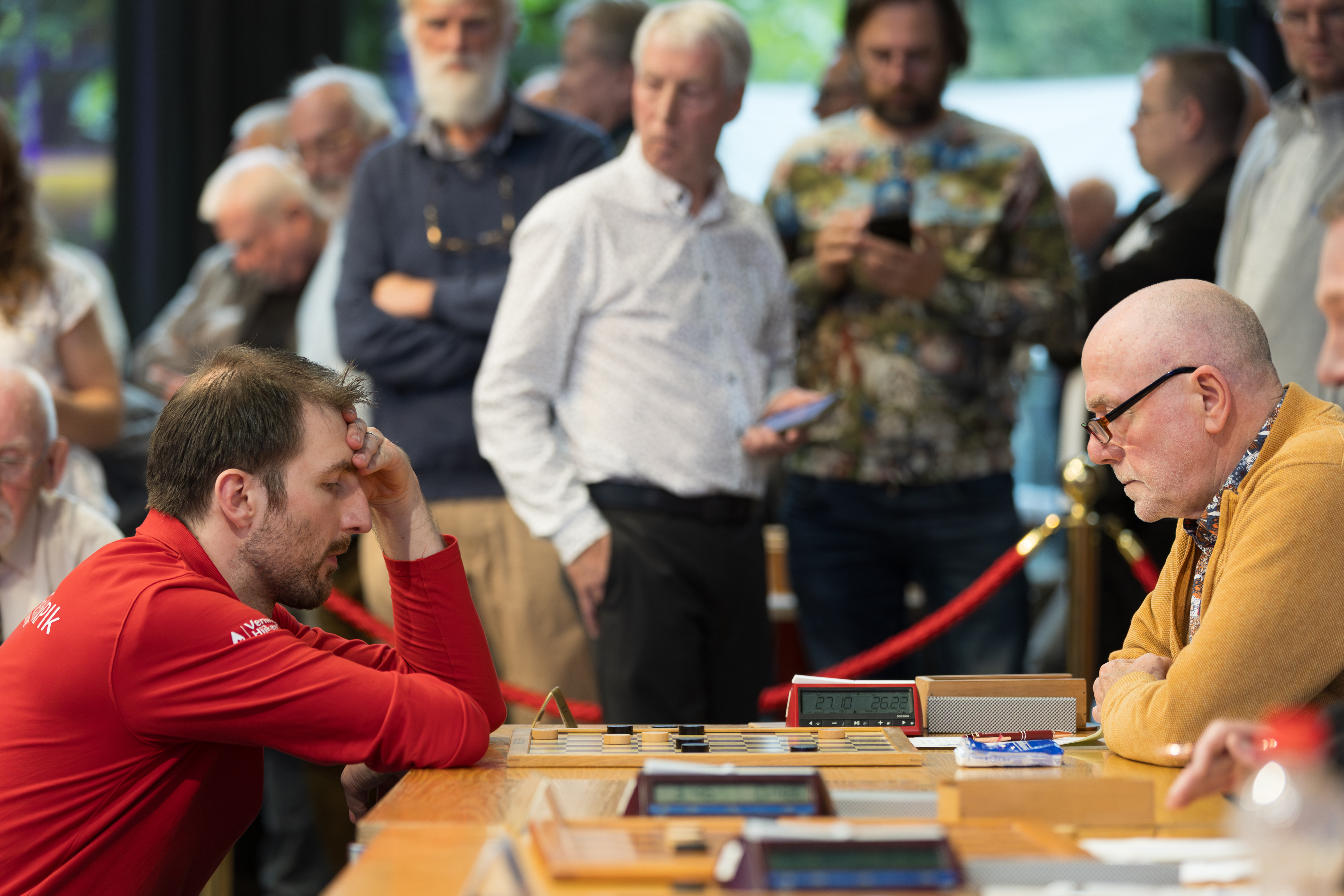
On Sunday, 12 October 2025, the moment had arrived: after a long period of preparation, I attempted the world record for a clock simultaneous exhibition in draughts in the studio of RTV Drenthe, facing 52 opponents.
The record was held by Martijn van IJzendoorn, who in 2023 achieved a crushing score of 88 percent against 50 players. I knew it would be a huge challenge, but at the same time Van IJzendoorn’s score still left some room for error — 70 percent is required to claim the world record.
In the end, I needed every bit of that margin. With 25 wins, 23 draws and 4 losses, I finished on 73 points, which turned out to be just enough: 70.19 percent!
In this article I analyse one of the games from the record attempt, while also describing how the attempt itself unfolded. The selected game — against Evert van de Pol — is perfect in that respect, because it was also the longest game of the afternoon. The game and the record attempt unfold, as it were, along two separate timelines that meet at the moment the final move is played.
At first glance the game against Van de Pol may not seem particularly exciting, apart from the tense final phase. Nevertheless, I think it perfectly illustrates the challenge of a clock simultaneous exhibition and the style of play that this discipline more or less forces upon the exhibitor. Because there is absolutely no time for deep calculation, the simultaneous player must rely largely on intuition, after briefly checking for tactical shots.
For that reason the exhibitor tries to steer the game toward simple positions, preferably with minimal tactical risk or the danger of serious disadvantage. This approach might be described as “playing technically”: focusing on sound development of the position without shying away from large exchanges.
In normal one-on-one games this strategy is often not the most effective, because the draw margin in our game is simply quite large. But in a simultaneous exhibition — especially against 52 opponents — the draw margin is much less of a problem. In fact, beforehand I could even afford 31 draws, as long as I avoided losing games.
That concludes the introduction. Let us move on to the game. Since, as mentioned, there was no time for deep calculations, I will mostly keep the comments technical. Only in the final phase — when the result is decided and I finally had some time to think again — will I give longer variations, with some attention to endgame knowledge as well.
Enjoy the read!