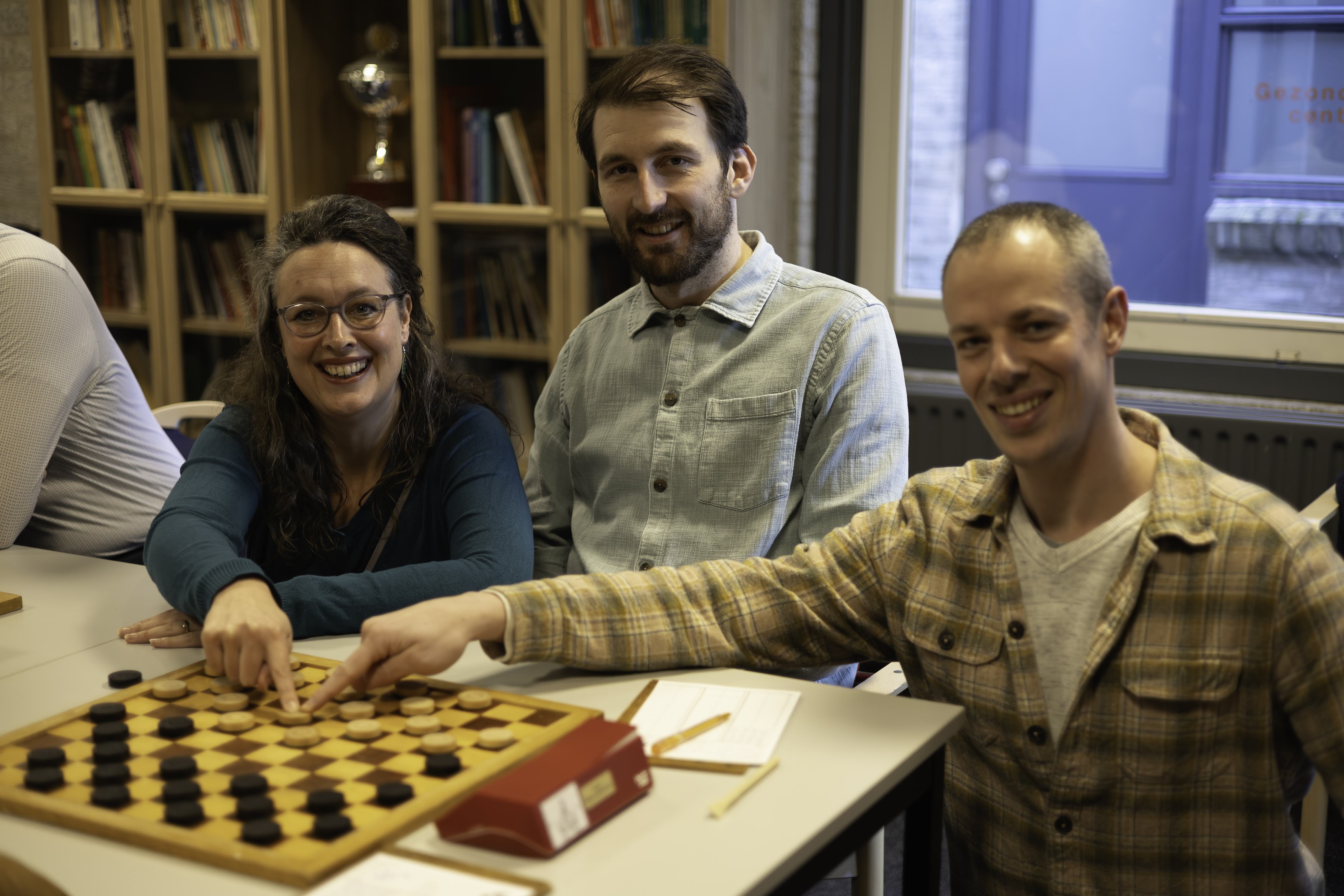
The inaugural Evert Bronstring Memorial took place in Leiden on the weekend of 17–18 January 2026. It marked the fifth anniversary of the passing of the Leiden grandmaster, making it a fitting occasion not only to organize a tournament in his honour, but also to present a book celebrating the life and career of this remarkable draughts player.
As soon as I heard about the event, I knew I wanted to take part. I no longer have the email I sent to Steven den Hollander—I try to keep my digital footprint as small as possible—but it went something like this:
Hi Steven,
Of course I'll be playing in the Evert Bronstring Memorial. I simply couldn't let this event pass me by.
Evert was my greatest source of inspiration during the 1970s. I was a huge admirer of his and I still remember how thrilled I was to witness the 1976 Dutch Championship in Apeldoorn, where Evert competed alongside other heroes of mine such as Frans Hermelink, Rob Clerc and Harm Wiersma.
Incidentally, that was the last time the Dutch Youth Championship was held alongside the senior Dutch Championship, at Hotel Nieland.
There I was, a sixteen-year-old among the country's best players—an unforgettable experience!
Best,
Tjeerd
Why was I such a devoted admirer of Bronstring? It must have been his adventurous style of play, combined with the fact that his games regularly featured in the draughts columns of the national newspapers. I'm talking about the 1970s, when I eagerly followed the columns written by Andreas Kuyken (NRC), Ton Sijbrands (Algemeen Dagblad and later de Volkskrant), Harm Wiersma and Jaap Metz (De Telegraaf), and Frank Drost (Trouw).
Bronstring's name is inseparably linked with the fork lock without piece 15, and I still remember how proud I was of the first game in which I employed that system. It was during the 1974 Gelderland Aspirants Championship against Nico Floor. Since then, I have used this system in well over thirty official games, not to mention countless club games. Another of Bronstring's trademarks was the Half Open Classical, an opening I have always enjoyed playing as well—naturally from the encircling side.
A few words about Bronstring himself. Following his death on 14 January 2021, much was written about his life and achievements. Damspel published an extensive obituary by Fred Ivens and Ton Sijbrands, while Joop Burgerhout contributed a fine retrospective on Bronstring's life in draughts for the Zuid-Holland Draughts Association. By the time of the tournament, the first proof copy of a book devoted to Bronstring could already be viewed.
This is not the place to revisit his life in detail; readers can easily consult the publications mentioned above. A few key facts will suffice. Bronstring grew up in Haarlem, studied mathematics in Leiden and joined LDV—later renamed LDG (Leids Damgenootschap)—where he remained a lifelong member. He earned the title of National Grandmaster, a distinction also celebrated in Evert Dollekamp's booklet Verroest!, Evert's tribute to Evert. Bronstring was a philosopher, a teacher of both mathematics and draughts, a fourteen-time participant in the Dutch Championship, and above all a passionate lover of the game whose flashes of brilliance bordered on genius.
As mentioned earlier, forty enthusiasts gathered in Leiden on the weekend of 17–18 January 2026 to compete in the spirit of Evert Bronstring. Every game began from one of a number of pre-selected openings devised by Ton Sijbrands. The organizing committee of LDG (Leids Damgenootschap)—Steven den Hollander, Jack van der Plas and Joop Burgerhout—welcomed Ton Sijbrands as guest of honour and chairman of the jury that would award the prizes for the tournament's most attractive games.
A great admirer of Bronstring's uncompromising style himself, Sijbrands selected the following opening positions:
Opening 1
1.32-28 18-23 2.33-29 23x32 3.37x28 20-25 4.41-37 17-21 5.37-32 15-20 6.46-41 21-26 7.41-37 19-24
(Players were not allowed to simplify the position in the following moves by playing 34-30 (25x23) 28x30.)
Opening 2
1.31-27 18-23 2.36-31 12-18 3.33-28 17-22 4.28x17 11x22 5.41-36 8-12 6.27-21 16x27 7.32x21 6-11 8.21-16
Opening 3
1.33-28 17-21 2.39-33 21-26 3.44-39 18-23 4.31-27 11-17 5.50-44 17-21 6.36-31 20-25 7.33-29 14-20 8.29x18 13x33 9.39x28 19-24
The players were divided into groups of four, with each group playing three games from the opening positions above, none of which had been disclosed in advance. Every pair of groups was balanced by rating. For example, Group A contained the players ranked first, third, sixth and seventh on the rating list, while Group B comprised numbers two, four, five and eight. The same principle was applied throughout the tournament. After the three preliminary rounds, the group winners advanced to the knockout stage. The winner of Group 1 met the winner of Group 2 to decide the tournament champion, while the winners of Groups 3 and 4, 5 and 6, and so on, played for the remaining places. In the event of a tie in the preliminary standings, the player with the lower rating progressed.
The knockout games were played at a rapid time control and, appropriately enough, all began from a Half Open Classical opening:
1.32-28 17-21 2.31-26 20-24 3.26x17 12x21 4.34-30 7-12 5.30-25 21-26
The time control for the main tournament followed the FMJD standard: ninety minutes for the first forty moves, followed by an additional thirty minutes, with an increment of thirty seconds per move. Because the tournament format differed from the standard regulations, the results did not count for rating purposes. The knockout games, however, were played at a rapid time control.
By some margin the strongest player in the field was TeamNL member Wouter Sipma. A friend of Bronstring's, he is also the custodian of the legendary Great Book of Variations, in which Bronstring meticulously recorded his handwritten analyses. It therefore came as no surprise that Sipma won the tournament. He defeated Jeroen Kos and Joost Hooijberg and drew with Koos van Amerongen in the preliminary stage. His opponent in the final was Frits Luteijn, who had qualified by defeating Tjeerd Harmsma and drawing with Jan van der Star and Klaas Bor. Playing Black, and adopting the encircling strategy that Bronstring so often favoured, Sipma won the final convincingly. The other group winners were Henk Ruesink, Siep Buurke, Cock van Wijk, Martin de Jong, Eelco Kuipers, Hans de Groot, Koos Groeneveld and Matthijs Broek.
I will now hand over to Koos van Amerongen, a member of WSDV Wageningen, Zenderstad IJsselstein and LDG, who has carried out an in-depth analysis of several of the tournament's many entertaining and beautifully played games.
Enjoy!